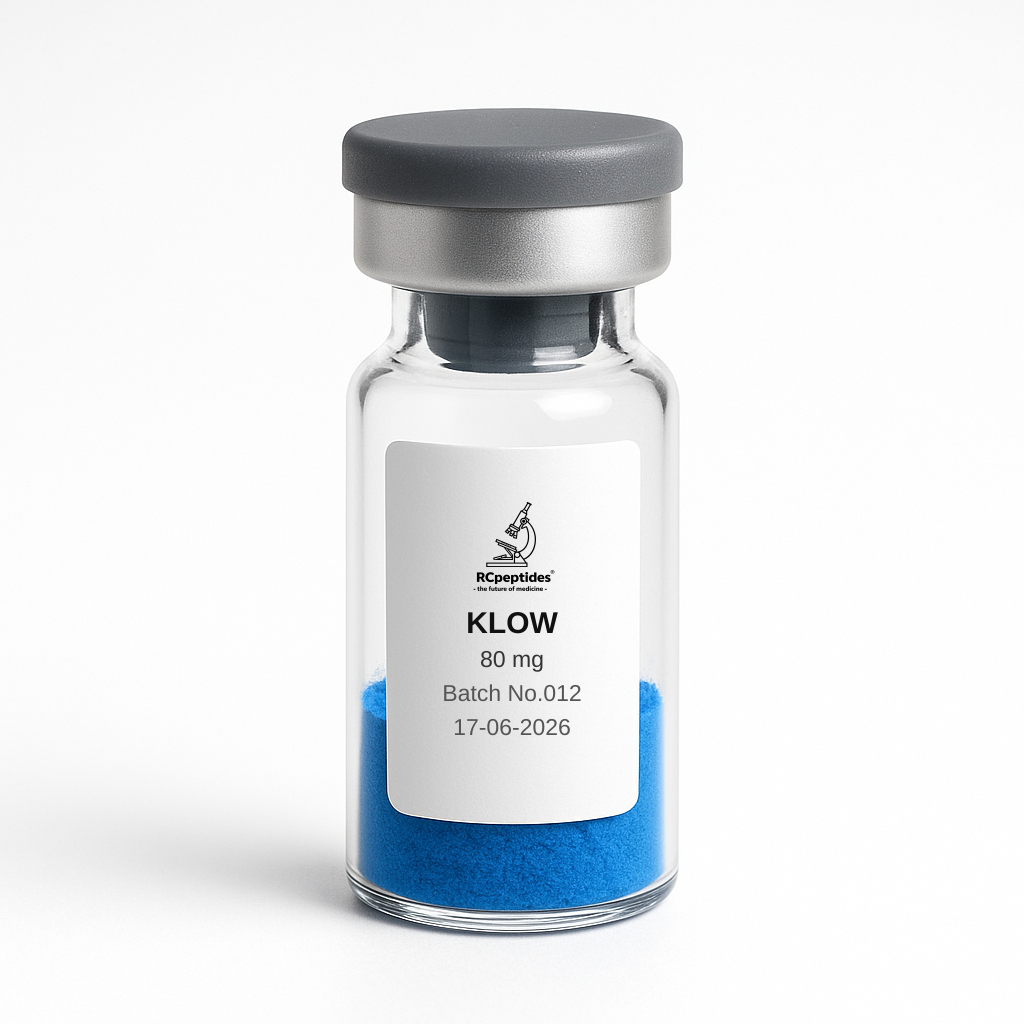
KLOW 80 mg peptide vial with blue lyophilized powder, labeled Batch No.005, dated 23-01-2026, pharmaceutical glass vial with rubber stopper and metal seal.

KLOW 80mg vial

€135,00 EUR
Skip to product information
KLOW 80 mg peptide vial with blue lyophilized powder, labeled Batch No.005, dated 23-01-2026, pharmaceutical glass vial with rubber stopper and metal seal.

KLOW 80mg vial

€135,00 EUR
Taxes included.

                                                 NOT FOR HUMAN CONSUMPTION

KLOW peptide blend (GHK-Cu + BPC-157 + TB-500/Tβ4 + KPV)

KLOW as a blend is not an FDA/EMA-approved medicine and (critically) has no robust, published human clinical trials as a combined formulation. Evidence must be inferred from individual ingredient literature (mostly preclinical), plus limited human data for some components (notably thymosin-β4 ophthalmic programs). (ClinicalTrials)


1) Additional Benefits Now Under Investigation (component-driven, not blend-proven)

BENEFIT KEY TAKE-AWAYS
1. Tissue repair & wound-healing signals GHK-Cu is widely studied for wound-healing biology (ECM remodeling, antioxidant/repair gene programs) largely in animals/cell systems; thymosin-β4 supports cell migration/repair signals in ocular and other injury models. (PMC)
2. Anti-inflammatory / gut-immune modulation KPV (Lys-Pro-Val) shows anti-inflammatory activity in colitis models, including NF-κB pathway suppression in preclinical work. (PubMed)
3. Angiogenesis / cytoskeletal & migration pathways Thymosin-β4 is linked to actin dynamics, cell migration, and angiogenic signaling in injury contexts (largely preclinical). (PMC)
4. “Systemic recovery” claims (muscle/tendon, etc.) BPC-157 is heavily preclinical; human evidence is limited/fragmentary. It has been discussed in the context of GI/IBD development programs (PL-14736), but broad recovery claims are not backed by high-quality human RCTs. (PubMed)
5. Dermatology/cosmetic-type signals GHK-Cu is strongly associated with skin biology and collagen/ECM pathways in lab and animal work; translation to strong clinical outcomes depends on formulation/route and trial quality. (PMC)

Evidence quality reality check: for KLOW specifically, you’re largely in mechanistic + animal/cell data territory, with limited rigorous human evidence across the stack (strongest human program signal is thymosin-β4 eye-drop development rather than TB-500 “recovery” use). (ClinicalTrials)


2) Molecular Mechanism of Action

2.1 Receptor / pathway pharmacodynamics (by component)

  • GHK-Cu (copper tripeptide complex): influences ECM remodeling, growth/repair gene expression, antioxidant defenses, and fibroblast activity in multiple models. (PMC)

  • Thymosin-β4 (TB4; “TB-500” is often used commercially for TB4-related products): regulates actin sequestration, cell migration, inflammation modulation, and wound repair signals—especially studied in corneal injury and related ocular settings. (PMC)

  • KPV (Lys-Pro-Val): anti-inflammatory effects shown in gut/immune models; reported to reduce inflammatory signaling (including NF-κB-related pathways) in preclinical colitis work. (PubMed)

  • BPC-157: proposed to affect cytoprotection, angiogenic and NO-system related pathways in diverse preclinical injury models; human evidence remains limited. (PubMed)

2.2 Down-stream biology (conceptual map)

PATHWAY / DOMAIN FUNCTIONAL OUTCOME (hypothesized) CONTEXT
ECM / collagen / fibroblast signaling (GHK-Cu) remodeling + repair gene programs skin/wound models (PMC)
Actin dynamics, migration (TB4/TB-500) re-epithelialization, repair signaling corneal/injury models (PMC)
NF-κB / inflammatory cascades (KPV) inflammatory tone ↓ in models colitis/inflammation models (ajp.amjpathol.org)
Cytoprotection / vascular signaling (BPC-157) broad protective claims (mostly preclinical) GI + injury models (PubMed)

3) Pharmacokinetics (PK): what can and can’t be said

Because KLOW is a blend and is commonly sold as a lyophilized research vial, there’s no single validated human PK profile for “KLOW.” 
General points:

  • Peptides often have short systemic half-lives unless modified (PEGylation, albumin-binding, lipidation, etc.).

  • Route matters (topical/ocular vs systemic), and TB4 ophthalmic development is its own formulation/PK story. (ClinicalTrials)


4) Pre-clinical and Clinical Evidence (what exists)

4.1 GHK-Cu

  • Substantial mechanistic + animal evidence supports wound-healing biology; reviews summarize broad regenerative signaling themes. (PMC)

  • Human evidence exists in various topical/cosmetic contexts, but strength depends on study design and endpoints (often not comparable to drug-grade RCTs). (PMC)

4.2 Thymosin-β4 / “TB-500”

  • Strong preclinical rationale for wound repair, and there are registered clinical trials for thymosin-β4 ophthalmiccandidates (e.g., RGN-259/TB4 eye drops). (ClinicalTrials)

  • Claims made for “TB-500” in athletics/recovery contexts generally outpace published human RCT evidence.

4.3 KPV

  • Multiple preclinical papers show KPV can reduce intestinal inflammation in mouse colitis models and modulate inflammatory signaling. (PubMed)

4.4 BPC-157

  • Frequently cited as having IBD development history under PL-14736, but publicly accessible, high-quality clinical data are limited; much of the literature is review/position style plus extensive animal work. (PubMed)

Bottom line: the blend has no clear clinical evidence base as a combined product; the best-substantiated clinical pathway among the ingredients is TB4 in ocular indications (still not broadly “recovery” validated), while GHK-Cu/KPV/BPC-157 are dominated by preclinical evidence. (ClinicalTrials)


5) Emerging clinical interests (hypothesis-driven)

FIELD RATIONALE STATUS
Wound healing / tissue repair GHK-Cu + TB4 biology mostly preclinical; TB4 ocular programs registered (ClinicalTrials)
Inflammatory bowel disease / gut inflammation KPV + BPC-157 narratives mainly animal/mechanistic; limited clinical transparency for BPC-157 (ajp.amjpathol.org)
Dermatology / skin remodeling GHK-Cu ECM signaling mixed evidence; many non-drug cosmetic studies (PMC)

6) Safety and tolerability (real-world caution)

Because KLOW is typically sold as a research-only blend, there is no authoritative, product-specific safety label and risks depend on purity, sterility, dosing, route, and user factors
Key safety uncertainties:

  • Sterility/contamination risk (especially for non-pharmaceutical supply chains).

  • Immunogenicity/allergy risk (peptides can provoke immune responses).

  • Copper complex considerations (GHK-Cu): local irritation/unknown systemic effects at non-studied exposures.

  • Off-target effects: combining multiple bioactive peptides increases uncertainty.

If you want, tell me what context you’re writing for (research overview vs consumer education vs clinician-style brief), and I’ll tune the safety section to match.


7) Regulatory landscape

  • KLOW blend: not an approved drug; commonly labeled “for laboratory research use only” by sellers. 

  • TB4 ophthalmic candidates: have been studied in formal clinical trial settings (still not equivalent to broad approval). (ClinicalTrials)


8) Future directions (what would “real answers” require?)

  1. Define the blend (exact sequences, salts, copper stoichiometry, excipients, sterility, stability).

  2. PK/PD bridging: show exposure and biomarker engagement for each component when co-formulated.

  3. Controlled human trials with clinically meaningful endpoints (wound closure time, validated pain/function scores, endoscopic/histologic IBD endpoints, etc.).

  4. Safety programs: immunogenicity, infection/sterility assurance, organ-system monitoring.


Selected references (most relevant)

  • KLOW composition and “research-only” positioning (examples of typical formulation): 

  • GHK-Cu regenerative/wound-healing review and in-vivo wound biology: (PMC)

  • Thymosin-β4 corneal wound-healing background + clinical trial registry entry: (PMC)

  • KPV anti-inflammatory activity in colitis models / NF-κB pathways: (PubMed)

  • BPC-157 overview including PL-14736/IBD development mentions (limits noted): (PubMed).